
The Modern World in Chaplin’s Films
This blog is written as part of an academic engagement with the Modern Age in English Literature, informed by A. C. Ward’s historical perspective and the critical framework developed by Prof. Dr. Dilip Barad, under whose guidance the thematic understanding of Chaplin’s cinema is explored.
Introduction: Chaplin, Cinema, and the Spirit of the Modern Age

The Modern Age, as described by A. C. Ward, is not merely a historical period but a profound shift in human consciousness. It is characterized by rapid industrialization, technological innovation, scientific advancement, and large-scale political change. At the same time, it is marked by deep anxiety, moral confusion, psychological alienation, and social fragmentation. The devastation caused by the First World War, followed by economic depression and the rise of totalitarian regimes, shattered nineteenth-century faith in progress, reason, and human benevolence.

Modern English literature emerged from this crisis. Writers began to question authority, tradition, religion, and even language itself. Themes such as alienation, loss of individuality, mechanization of life, mass psychology, surveillance, and political oppression became central concerns. According to Ward, the modern writer no longer celebrates civilization but interrogates it.
Although Charlie Chaplin worked in cinema rather than literature, his films Modern Times (1936) and The Great Dictator (1940) function as visual texts of the Modern Age. As Prof. Dilip Barad suggests, Chaplin’s cinema can be read as a powerful cultural document that captures the ideological, political, and psychological tensions of the twentieth century. Through satire, symbolism, and comic exaggeration, Chaplin exposes the contradictions of modernity—where machines dominate humans, systems replace moral responsibility, and power becomes destructive.
This blog undertakes a detailed frame study of Modern Times and The Great Dictator to demonstrate how Chaplin’s visual language reflects the same anxieties and critiques found in Modern English literature.
Frame Study of Modern Times (1936)

Frame 1: The Assembly Line – Mechanization and the Birth of the ‘Mass Man’
The assembly line scene in Modern Times is one of the most iconic representations of industrial modernity. Chaplin’s Tramp is shown tightening bolts on a conveyor belt that moves at an increasingly rapid pace. His movements are repetitive, mechanical, and entirely dictated by the machine. The framing of the scene emphasizes the enormity of industrial machinery, while the worker appears small, replaceable, and insignificant.
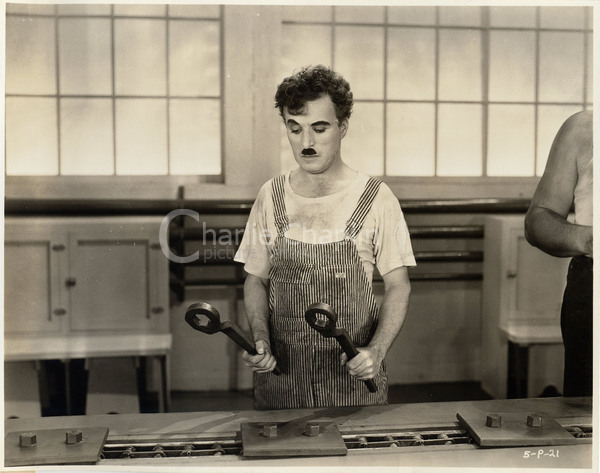
A. C. Ward argues that modern industrial society transforms individuals into what he calls “mass men” human beings stripped of individuality and reduced to functional units within a larger system. Chaplin visualizes this idea with striking clarity. The worker is no longer defined by skill, creativity, or thought but by speed and efficiency.
The moment when the Tramp’s hands continue tightening imaginary bolts even after he leaves the machine suggests that mechanization has invaded his nervous system. Humanity itself begins to behave like a machine. This aligns with D. H. Lawrence’s critique of industrial civilization as destructive to natural human instincts and emotions. Similarly, T. S. Eliot’s The Waste Land presents modern life as fragmented, repetitive, and spiritually empty. Chaplin’s physical comedy becomes a visual metaphor for the psychological breakdown of the modern individual.
Frame 2: The Feeding Machine – Scientific Progress Without Humanity
The feeding machine scene represents one of Chaplin’s most brutal satires on modern technological faith. Designed to eliminate lunch breaks and maximize productivity, the machine attempts to feed the worker automatically. Instead of helping, it violently assaults the Tramp, turning a basic human necessity into an experiment in control.

According to A. C. Ward, the Modern Age often equated scientific advancement with moral progress. Chaplin dismantles this assumption. The feeding machine symbolizes progress without ethical responsibility. It treats the worker as an object rather than a person.
Prof. Dilip Barad’s critical approach highlights how this scene exposes the ideology of industrial capitalism, where time is money and the human body is merely an instrument of production. The machine does not malfunction accidentally; it fails because its underlying logic is inhuman. This scene resonates with Aldous Huxley’s Brave New World, where technological perfection results in emotional emptiness and loss of freedom. Chaplin warns that progress, when detached from compassion, becomes violent.

Frame 3: Surveillance and Authority – The Emergence of Systemic Power
In another crucial frame, the factory owner monitors workers through large screens placed throughout the factory. He appears omnipresent but never physically present. Even private spaces are subjected to surveillance.
Ward observes that modern authority becomes impersonal and bureaucratic. Power is no longer exercised by visible individuals but by systems, institutions, and technologies. Chaplin visualizes this transformation by replacing human supervision with technological surveillance.
This anticipates George Orwell’s 1984, where constant observation becomes a tool of control, and Kafka’s The Trial, where authority is faceless and unreachable. As Prof. Barad’s blog suggests, Chaplin exposes how modern power disciplines individuals silently, making obedience seem natural. Freedom is not taken violently; it disappears gradually.

Frame 4: Prison as Security – The Irony of Modern Freedom
One of the most ironic moments in Modern Times occurs when the Tramp finds comfort, food, and stability inside prison, while life outside is marked by unemployment, hunger, and uncertainty. The prison offers routine and security, whereas freedom offers suffering.
This reversal reflects the economic realities of the Great Depression. Ward explains that modern capitalism failed to provide dignity and stability to ordinary people. Chaplin’s satire exposes the emptiness of political freedom when economic justice is absent.
This theme strongly echoes George Orwell’s The Road to Wigan Pier, which documents the suffering of the working class beneath promises of progress. Chaplin suggests that a society that cannot meet basic human needs has lost its moral foundation.
Frame Study of The Great Dictator (1940)
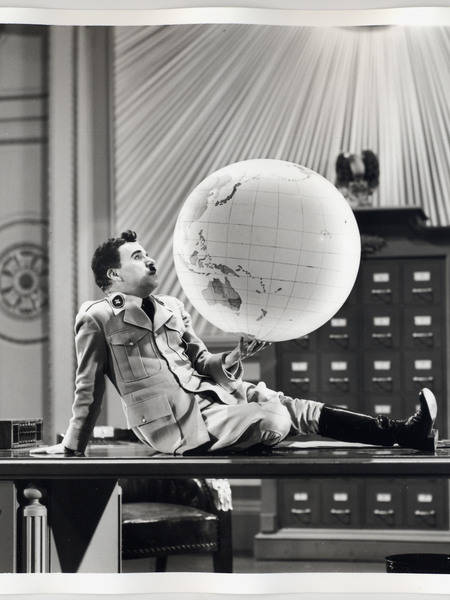
Frame 1: The Globe Dance – Power as Narcissistic Fantasy
The globe dance scene is one of the most symbolic moments in modern cinema. Adenoid Hynkel, Chaplin’s parody of Hitler, dances joyfully with a balloon shaped like the world. He treats it as a personal toy, caressing and controlling it.
This frame reflects Ward’s argument that modern political power expanded beyond moral restraint. The dictator’s relationship with the globe reveals power as narcissistic fantasy rather than responsibility. When the globe bursts, it symbolizes the fragility and self-destructive nature of authoritarian ambition.
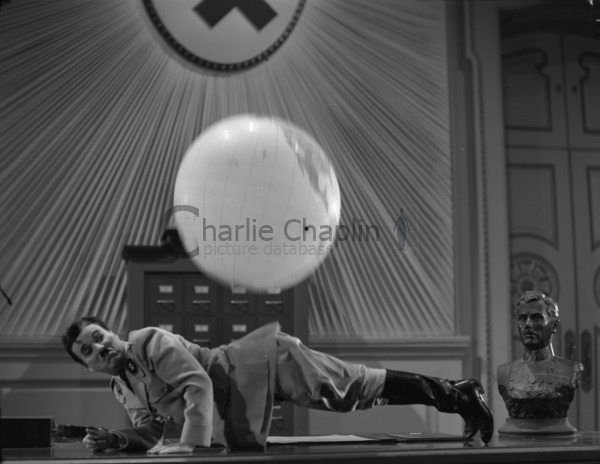
As Prof. Barad notes, Chaplin reduces dictatorship to absurdity, exposing its childishness and danger. The scene echoes Orwell’s idea that totalitarian power exists not to serve people but to dominate them.
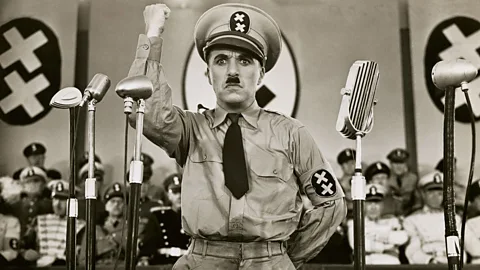
Frame 2: Mass Rallies and Propaganda – The Manipulation of the Crowd
The exaggerated mass rallies in The Great Dictator show how crowds are controlled through slogans, uniforms, symbols, and emotional speeches. Individual identity dissolves into collective obedience.

Ward identifies the Modern Age as an era of mass movements and mass psychology. Chaplin exposes how propaganda replaces reason and critical thinking. The crowd becomes mechanical, mirroring the factory workers of Modern Times. Both are controlled by systems larger than themselves.
This concern lies at the heart of Modern English literature’s fear of conformity and loss of individuality.

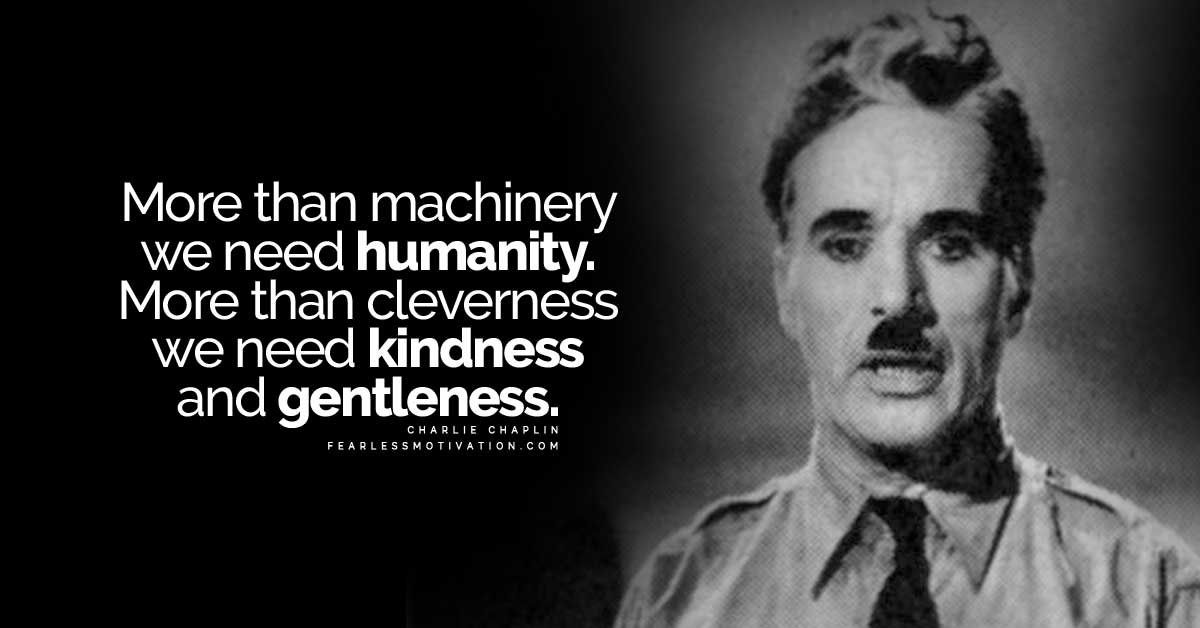
Frame 3: The Final Speech – Humanism as Resistance
The film concludes with Chaplin’s famous speech calling for democracy, compassion, and human unity. Unlike the distorted, mechanical language of dictators, this speech restores sincerity and moral clarity.
As Prof. Barad emphasizes, this speech marks Chaplin’s transformation from silent clown to moral voice. It represents the ethical impulse of the Modern Age the belief that art must confront injustice and affirm human values.
Conclusion
Charlie Chaplin’s Modern Times and The Great Dictator function as cinematic expressions of the Modern Age described by A. C. Ward and critically examined by Prof. Dilip Barad. Through satire, symbolism, and visual storytelling, Chaplin critiques industrial dehumanization, economic injustice, surveillance, mass psychology, and authoritarian power.
Like the modern writers of his age, Chaplin exposes the failures of modern civilization while refusing to abandon humanity altogether. His films remind us that even in a world dominated by machines and dictators, compassion, freedom, and moral responsibility remain possible. In this sense, Chaplin’s cinema stands as a powerful visual companion to Modern English literature, capturing both the crisis and the conscience of the twentieth century.


0 Comments